
Your Business Isn't Stuck Because You Lack Strategy. It's Stuck Because the Wrong Expertise Is in the Room.


In an era of economic uncertainty, slowing innovation, and relentless competitive pressure, the CEOs and COOs who are winning aren't spending more on big consulting. They're spending smarter - with Maestro.
Every business leader reading this has sat in a boardroom, stared at a growth target and asked a version of the same question: What are we missing, and who do we need to unlock it? The instinct, for decades, has been to reach for the same two levers - hire someone permanent, or call a big consulting firm. In 2026, that instinct is increasingly costing organisations more than they realise.
The global business environment has shifted in ways that make the old playbook genuinely dangerous. Geopolitical volatility, tightening margins, tariff shocks, AI disruption, and a workforce transformation happening in real time mean that the luxury of slow, expensive, process-heavy interventions is no longer viable. And yet, the Big Four consulting firms - Deloitte, PwC, KPMG, EY - and the strategy houses - McKinsey, BCG, Bain - continue to operate on models built for a different era.
There is a smarter way to grow. And for a growing number of forward-thinking organisations across Australia, New Zealand, and Singapore, that smarter way is called Maestro.
The Real Problem Facing Business Leaders in 2026
Let's be precise about the challenge. The difficulty most CEOs and COOs face is not a shortage of ideas. Strategy decks and transformation roadmaps are rarely the bottleneck. The bottleneck is execution - the ability to translate strategic intent into measurable, commercial progress.
The global backdrop makes this harder. Economic uncertainty has risen sharply, driven by trade protectionism, geopolitical instability, and the disruption of entire industries by AI. While 71% of executives remain optimistic about their own company performance, only 28% are optimistic about the global economy - and nearly a quarter of business leaders still believe a recession is either underway or imminent. J.P. Morgan
The temptation in such an environment is to pull back, to protect the current year, to run lean and wait for clarity. That is the most common mistake leaders make - and research bears it out. Research from McKinsey shows that in times of uncertainty, business as usual - investing only in incremental changes - is actually riskier than bold innovation. ITONICS The companies that emerge stronger from downturns are those who used the turbulence to reposition, not just to survive.
The question for leaders isn't whether to act. It's how to act with precision, speed, and without incurring structural costs that handcuff the organisation for years to come.
What the data shows:
- 73% of business leaders hold a cautious or pessimistic global outlook heading into 2026 J.P. Morgan
- Companies using fractional experts report up to 40% in leadership cost savings and a 35% boost in problem-solving capability
- Organisations using fractional models report 72% greater responsiveness to change Maestro
Why Innovation Is Slowing Inside Large Organisations
Here is an uncomfortable truth that most boards don't say out loud: corporate innovation is stalling. Not because people are lazy or unambitious - but because the structural conditions inside large organisations actively suppress it.
Silos fragment good ideas. Bureaucracy slows decision-making. Risk aversion, exacerbated by economic pressure, causes leadership teams to default to incremental moves. And the people with the freshest, most commercially relevant expertise - those who've been in the trenches of transformation at multiple organisations - are not sitting in permanent roles inside your company. They're operating independently.
Gartner has warned that in 90% of enterprise AI deployments, growth will stall because the costs of implementation will exceed value creation. ITONICS The reason isn't the technology. It's the absence of the right expertise to deploy it well, aligned to the specific context and goals of the organisation.
Research on corporate innovation consistently identifies the same failure mode: 57% of innovation departments identify stakeholder misalignment as one of the top three reasons innovative projects fail. ITONICS It's not a lack of ideas. It's a lack of the right people, in the right configuration, with the right accountability, at the right time.
The organisations that will thrive long-term are not the ones protecting the current year. They are the ones building capability, clarity, and execution firepower - right now, while others are standing still.
For businesses, 2026 demands a recalibration of strategy. London Business School And that recalibration requires looking hard at the conventional approaches - big consulting retainers and permanent hires - and asking honestly whether they are still fit for purpose.
What's Wrong With the Old Model
The Big Consulting Firms
The promise from Deloitte, PwC, KPMG, EY, McKinsey, BCG, and their peers is compelling: world-class expertise, global networks, robust methodology. What organisations actually receive is often a different story.
You commission a large firm and receive a team you didn't personally choose. The senior partner who won the work appears at the kick-off meeting and occasionally for check-ins. The day-to-day delivery is executed by analysts and associates - talented, but not the senior, battle-tested experts you imagined when you signed the contract. You pay premium rates for junior delivery, layered with management overhead, coordinated from afar.
The output is often a comprehensive deck. Beautifully structured, well-researched, and thoroughly footnoted. Then the consultants leave. And the implementation — the hard, messy, organisation-specific work of actually making it happen - falls back on the internal team that was already stretched before the engagement began.
The elite expertise big firms trade on is frequently white-labelled - the actual senior practitioners are often independent operators, not career employees of the firm. Maestro Boards and leadership teams are paying a significant premium for an intermediary layer that adds cost but not always commensurate value.
The Traditional Recruiter
The alternative - hiring a permanent executive or engaging a recruitment firm - solves for a different problem. A recruiter sends CVs and steps back. Maestro Their incentive is to fill the role, not to ensure it was the right role to fill in the first place.
Permanent hires are expensive, slow, and carry significant risk. The typical executive search takes months. Onboarding takes months more. If the hire is wrong - and the hidden costs of a misaligned senior hire can run into multiples of salary - the damage is real, structural, and difficult to undo.
More fundamentally, a permanent hire is an answer to a headcount question. But most of the growth problems organisations face are not headcount problems. They are capability-at-the-right-moment problems.
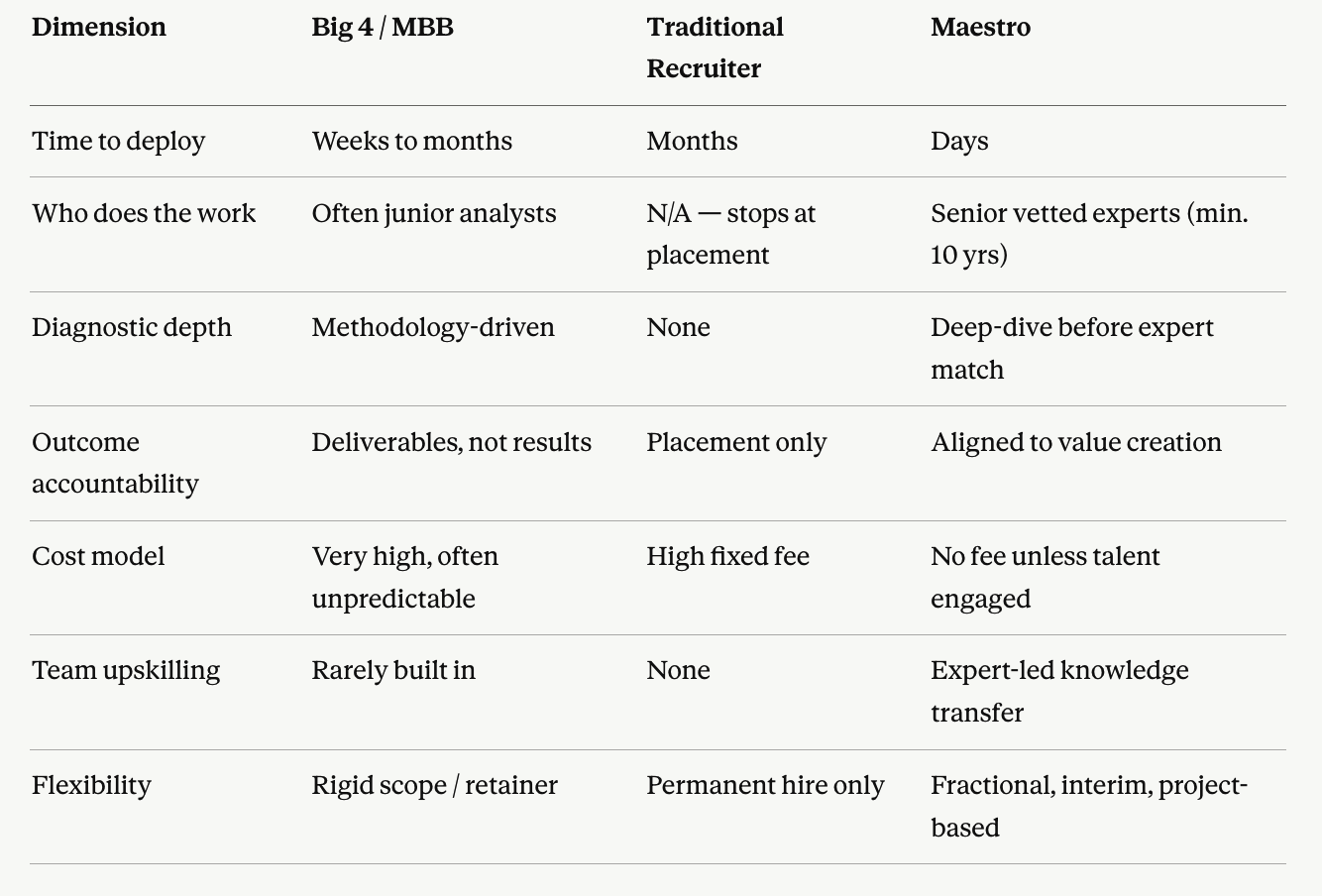
The comparison, plainly stated:
Maestro: The Value Creation Business
Here is what makes Maestro genuinely different from anything that has come before it, expressed as plainly as possible:
Maestro is not in the talent business. It is in the value creation business.
That distinction might sound like marketing language. It isn't. It reflects a fundamentally different operating model - one that begins not with a job description or a candidate shortlist, but with a question: Where is value being lost inside this organisation, and what kind of expert intervention will unlock it fastest?
Yes, Maestro connects organisations with extraordinary independent talent - fractional executives, interim leaders, and specialist consultants across every major business function. But the engagement doesn't start there. It starts earlier, and it goes deeper.
Most organisations do not suffer from a lack of resumes. They suffer from stalled momentum - value that is visible but not captured, strategy that is approved but not executed, capability that exists but is not aligned, and opportunities that sit dormant because no one has the time, clarity, or specialist firepower to move them forward. That is where Maestro matters. Maestro
Step One: The Diagnostic Deep Dive
Before any talent is matched, Maestro partners work closely with the organisation to understand the real shape of the challenge. Not the presenting problem - "we need a CMO" or "our operations are inefficient" - but the underlying dynamics: where is momentum stalling, what capability is genuinely missing, what does success actually look like, and what risks could derail it?
This diagnostic work is not a box-ticking front end. Poor diagnosis destroys value long before delivery begins. A vague brief produces a vague hire. A vague hire produces fuzzy accountability. Fuzzy accountability produces mediocre results - which then get blamed on execution, when the real failure was the lack of clarity at the start. Maestro
Good diagnosis saves money, saves management attention, and dramatically improves the probability that the intervention creates genuine return. It is the first act of value creation.
Step Two: Precisely Curated Expertise
Once the real problem is understood, Maestro matches the organisation not with the best available person from a generic database, but with the best fit - the expert whose specific capabilities, style, and track record align precisely to the challenge at hand.
Every expert in the Maestro community has been personally interviewed by a Maestro partner and carries a minimum of ten years of genuine senior leadership experience. The community currently numbers more than 550 senior experts. Maestro This is a curated cohort, not an open marketplace. The distinction matters because clients are not choosing in theory - they're choosing under pressure, with high-stakes problems and low tolerance for misfires.
The Maestro community spans every major business function: CFO and finance leadership, CMO and marketing, COO and operations, CTO and technology, strategy, people and culture, customer experience, and commercial growth. Many are practitioners who have led functions inside the very firms their industry benchmarks against.
Step Three: Embedded Execution
This is where Maestro diverges most sharply from a consulting firm. The expert doesn't arrive, assess, present, and leave. They get embedded. They become part of the team. They work alongside internal talent, drive initiatives forward, make decisions, solve problems, and hold themselves accountable for progress.
They are not writing recommendations for someone else to execute. They are the execution.
And as the engagement deepens, the real issues become visible. New opportunities surface. Hidden constraints come to light. Priorities can be refined. This is value optimisation in practice - not a fixed scope mechanically delivered, but a dynamic engagement that expands its own impact over time.
Step Four: Upskilling the Internal Team
The most sustainable growth leaves an organisation permanently stronger, not temporarily patched. Maestro experts are selected not just for what they can do, but for how they can transfer capability. Knowledge sharing, coaching, and deliberate handoffs are built into how they operate.
Fractional leaders who operate with a teaching mindset leave organisations with embedded systems, stronger teams, and frameworks that generate value long after the engagement ends. The internal team doesn't just observe - they learn. That is the compounding return that separates Maestro from every other model.
Read more: The Compounding Value of Fractional Leadership
How Maestro Helps You Grow: Five Things It Does Exceptionally Well
1. It identifies where value is hiding inside your organisation. Most businesses don't lose value randomly - they lose it systematically. Maestro's deep-dive diagnostic process maps the gap between current performance and unrealised potential, illuminating the specific friction points and missed opportunities that internal teams are too close to see clearly.
2. It explains why that value isn't being captured. Whether it's a capability gap, an execution failure, a misalignment between teams, or a strategic direction that needs sharpening - Maestro gives you a clear-eyed diagnosis of the root cause, not just the symptoms. This saves you from investing in the wrong solution.
3. It brings in precisely the right expertise to unlock it. From a fractional CFO to reframe your financial architecture, to a senior CMO to rebuild your growth engine, to an independent strategy expert to challenge your direction - Maestro deploys senior, vetted, contextually matched talent in days, not months.
4. It expands the value created during the engagement. Unlike a fixed consulting scope, Maestro engagements are designed to deepen and adapt. As the expert embeds into the organisation, the full complexity of the opportunity becomes visible - and the intervention can be calibrated accordingly. You get more than you originally scoped.
5. It leaves your organisation permanently stronger. The right Maestro doesn't just do the job. They leave the business with more capability, clearer systems, and a team that has been elevated by working alongside world-class expertise. That is the compounding return that separates Maestro from every other model.
The Long Game: Building for 2030, Not Just 2026
The pressure to manage the current year is real. Economic uncertainty, margin compression, and investor scrutiny mean that most leadership teams are operating in a permanently short-horizon mindset. This is understandable. It is also, if left unchecked, dangerous.
Harvard Business School faculty have identified that the most successful organisations in uncertain environments run many small, disciplined experiments rather than placing single large bets - and they invest heavily in human judgment and domain expertise as the complement to technology. Harvard Business School
This is the Maestro operating model made explicit. You don't need to commit to a permanent C-suite hire to get C-suite calibre thinking on your most important strategic questions. You don't need a multi-year consulting retainer to get deep, expert-led transformation. You need the right person, with the right experience, embedded at the right moment - accountable for moving your business forward.
Each well-designed engagement builds on the last, leaving the organisation progressively more capable, more aligned, and better positioned for the next phase of growth. The business doesn't just grow - it gets better at growing.
Read more: Orchestration: The New Core Competency for High-Growth Organisations
Who Maestro Is For
Established businesses navigating transformation. Organisations with strong foundations that are facing disruption, competitive pressure, or the need to evolve their model - and aren't sure how to do it with the team they currently have.
Scale-ups accelerating growth. Businesses that have found product-market fit and are now building the operational, commercial, and strategic infrastructure to scale without breaking. A fractional COO, CMO, or CFO can be the difference between controlled scaling and chaotic growth.
Boards and leadership teams that have identified a gap. Not necessarily a headcount gap - a capability gap. The kind where you know something important is missing, you're not sure exactly what it is, and you can't afford to spend six months finding out.
PE and VC-backed organisations. Where execution velocity and capital efficiency matter most, and where repeatable access to top-tier expertise across portfolio companies is a genuine competitive advantage.
Maestro currently serves organisations across Australia, New Zealand, Singapore, and the broader Asia-Pacific - with a community of more than 550 senior experts, every one personally vetted and carrying a minimum of a decade of genuine leadership experience. There are no search fees or retainers - you don't pay unless you actually engage talent.
Read more: How to Engage Fractional Experts, Interim Executives and Independent Consultants
The Smarter Way to Grow
The businesses that will define their industries over the next decade are not the ones that found the biggest consulting firm or hired the most permanent executives. They are the ones that got better at deploying the right expertise at the right moment - with precision, speed, and genuine accountability for outcomes.
They stopped thinking about growth as a headcount problem and started thinking about it as a value creation problem. They built internal capability rather than creating dependency. They moved faster than their competitors not because they had more resources, but because they used them better.
Maestro exists for exactly that kind of organisation. Not to send you CVs and step back. Not to dispatch a team of analysts and return with a deck. But to get inside your business, understand where your value is stuck, bring in the experts to unlock it, and leave you permanently stronger for the engagement.
In a world of economic uncertainty and relentless competitive pressure, that is not just a smarter alternative to the old model. It is a genuinely better way to grow.
Maestro is the platform and community connecting organisations across Australia, New Zealand, Singapore, and Asia-Pacific with highly vetted fractional executives, interim leaders, and independent consultants. To explore how Maestro can help your organisation grow, visit letsmeaestro.com or submit a brief at letsmaestro.com/hire-talent.
Further reading from Maestro:
Author
Related Articles
Empowering the workforce of the future.




Join the Future
Reimagine how fractional experts drive value for organisations
Discover how Maestro connects organisations with highly experienced experts and reimagines the future of work for talent.